
Actuary CV/Resume Template
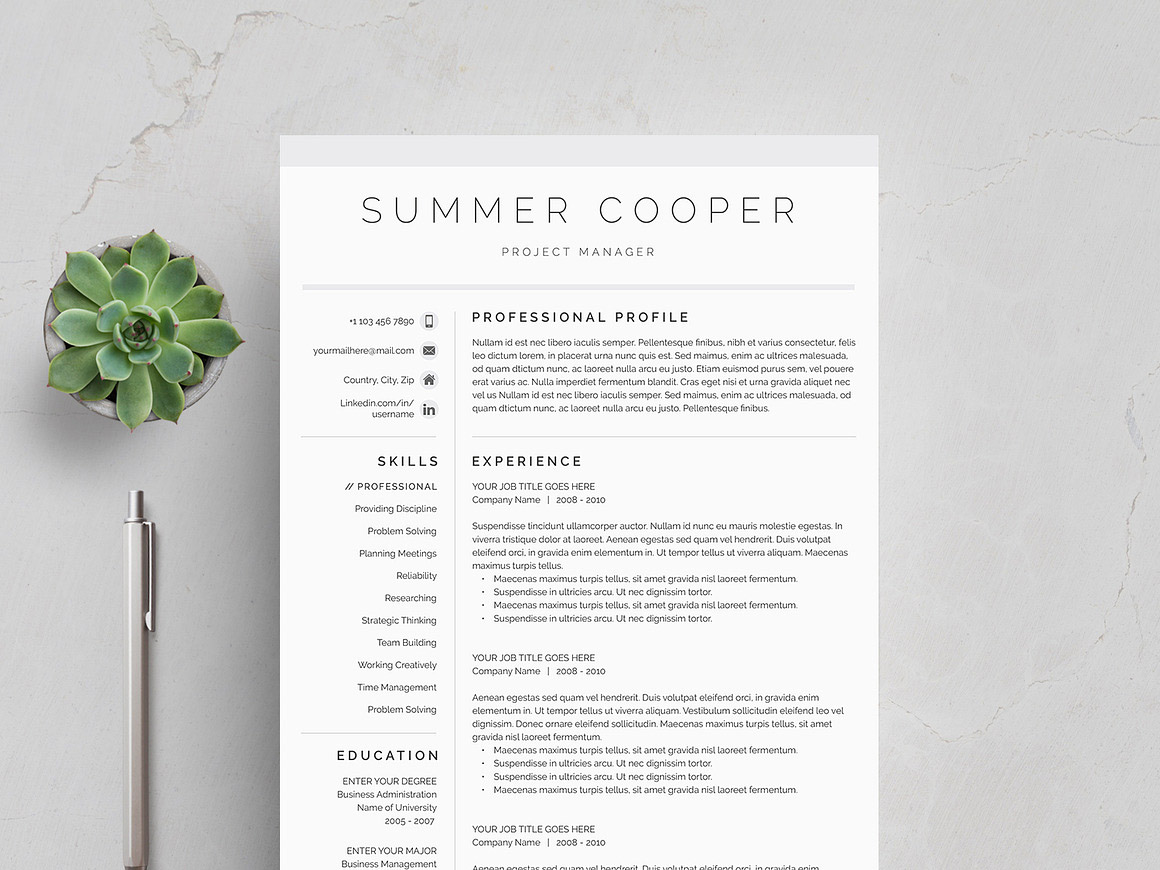
Actuaries help organizations understand uncertainty, quantify financial risks, and make informed long-term decisions. By combining statistical methods, financial principles, and predictive modeling, they support decisions involving insurance premiums, reserves, pension liabilities, healthcare costs, and capital requirements.
For professionals pursuing opportunities in insurance, consulting, banking, pensions, and corporate risk management, a well-organized resume can communicate both technical expertise and business understanding. The Actuary Resume Template provides a structured way to present actuarial experience, professional examinations, qualifications, analytical projects, and career achievements.
Designed for Microsoft Word, this resume package includes one-page, two-page, and three-page resume options, along with a matching cover letter and references template. The different lengths allow candidates to choose a format that reflects their experience, career stage, and application requirements.
Highlight Your Actuarial and Quantitative Expertise
Actuarial professionals work with complex datasets and mathematical models to evaluate potential outcomes and financial exposure. Their responsibilities vary by specialization, but often involve statistical analysis, forecasting, risk measurement, pricing, reserving, and regulatory reporting.
This template provides a foundation for showcasing relevant expertise in areas such as:
- Actuarial analysis and risk quantification
- Statistical and predictive modeling
- Insurance pricing and product analysis
- Claims forecasting and reserving
- Financial projections and scenario analysis
- Data interpretation and visualization
- Pension valuation and retirement benefits
- Capital modeling and solvency assessment
- Regulatory reporting and compliance
- Business intelligence and decision support
When describing these capabilities, include examples of how your work supported business decisions. You might explain how you developed a forecasting model, analyzed claims trends, evaluated pricing assumptions, or contributed to a reserve assessment.
Where appropriate, identify the methods, tools, or results associated with your work. Avoid presenting confidential datasets, proprietary assumptions, or sensitive financial information in a public-facing resume.
Complete Resume and Application Package
The template includes a collection of editable documents and supporting resources for preparing a professional application.
- One-page resume (.DOCX): A concise option for presenting essential qualifications and selected achievements.
- Two-page resume (.DOCX): Additional room for professional experience, technical skills, and actuarial projects.
- Three-page resume (.DOCX): A longer format for candidates with extensive experience, specialized responsibilities, or substantial professional qualifications.
- Matching cover letter (.DOCX): A supporting document for explaining your suitability for a specific actuarial position.
- References template (.DOCX): A separate document for organizing professional references when requested.
- A4 and US Letter sizes: Page formats for different application requirements.
- 22 professional icons: Optional design elements for the resume layout.
- Font guide: Instructions for working with the template’s typography.
- Resume writing tips: Guidance for presenting your professional background.
- FAQ and help guide: Supporting documentation for customization.
- Customer support: Assistance included with the package.
Having several resume lengths available makes it easier to select a format that suits your career history. Early-career applicants may benefit from a concise document focused on education, examinations, internships, and technical skills. Experienced professionals can use the longer format to explain specialized projects, leadership responsibilities, and professional development.
Easy Customization in Microsoft Word
The DOCX format allows you to edit the resume in Microsoft Word and compatible word-processing applications. You can adapt the content to reflect your qualifications without needing specialist graphic design software.
Customization options include:
- Replacing placeholder text with your personal information
- Updating employment history and project descriptions
- Adding actuarial examinations and professional credentials
- Including relevant technical software and programming languages
- Adjusting colors and editable design elements
- Rearranging sections to prioritize your strongest qualifications
- Tailoring your resume to insurance, consulting, pension, or risk roles
- Personalizing the cover letter for each employer
For actuarial applications, ensure that your examination progress and professional designations are accurately represented. Clearly distinguish between examinations passed, examinations in progress, and credentials already awarded.
Professional Formatting and ATS Considerations
Insurance companies, consulting firms, financial institutions, and other employers may use Applicant Tracking Systems (ATS) to manage recruitment. A clear document structure can make qualifications easier to review, although compatibility depends on the document’s text structure and the particular system used.
Consider the following practices when editing the template:
Use recognizable section headings. Headings such as Professional Experience, Education, Actuarial Examinations, Technical Skills, and Certifications help organize information.
Keep essential details in editable text. Important qualifications should not appear exclusively inside graphics or icons.
Use relevant technical keywords. Include terms such as actuarial modeling, reserving, pricing, statistical analysis, and risk assessment when they accurately describe your experience.
Review the reading order. Check that the content follows a logical sequence when copied into a plain-text editor.
Follow the employer’s instructions. If a job application requests a specific file type or a simplified resume, prepare a version that meets those requirements.
The template’s visual design can support a professional presentation, but ATS performance is not guaranteed by appearance alone. Accuracy, relevant experience, and clear descriptions of your qualifications remain essential.
Who Can Use This Actuary Resume Template?
The template can be adapted for a variety of careers involving actuarial science, quantitative analysis, insurance, and financial risk.
Insurance and Actuarial Practice
- Actuarial Analyst
- Pricing Actuary
- Reserving Analyst
- Life Insurance Actuary
- Property and Casualty Actuary
Pensions and Employee Benefits
- Pension Actuarial Consultant
- Retirement Benefits Analyst
- Pension Risk Specialist
- Employee Benefits Consultant
- Retirement Valuation Analyst
Financial and Enterprise Risk
- Financial Risk Analyst
- Capital Modeling Analyst
- Solvency Analyst
- Enterprise Risk Management Specialist
- Quantitative Risk Analyst
Data, Modeling, and Consulting
- Statistical Modeling Analyst
- Predictive Analytics Specialist
- Actuarial Data Scientist
- Insurance Analytics Consultant
- Financial Forecasting Analyst
These roles involve different technical requirements and responsibilities. A pricing actuary may emphasize rate development and profitability analysis, while a pension consultant may focus on retirement liabilities, funding assessments, and benefit projections. Customize your resume to highlight the expertise most relevant to the vacancy.
How to Strengthen an Actuarial Resume
1. Present Your Examination Progress Clearly
Actuarial examinations can be an important part of professional development. List the relevant examining body, examinations passed, and examinations in progress where appropriate. Use accurate terminology for your professional status and designations.
2. Explain Your Modeling Experience
Identify the types of models you have developed, maintained, or validated. Relevant examples may include pricing models, claims projections, reserve calculations, financial forecasts, or risk simulations.
3. Highlight Technical Tools
Depending on your experience, relevant tools may include Excel, SQL, R, Python, SAS, actuarial modeling platforms, and data visualization applications. Specify your actual level of proficiency and explain how you have used these tools in professional or academic projects.
4. Connect Analysis With Business Outcomes
Employers often need actuaries who can explain technical findings in practical terms. Describe how your analysis informed pricing decisions, financial planning, capital assessments, risk controls, or management reporting.
5. Choose the Right Resume Length
Use the one-page version when your relevant experience can be presented concisely. Consider the two-page option for a broader range of projects and responsibilities, or the three-page version when substantial experience and specialized qualifications warrant additional detail.
The best choice depends on the role, your career history, and the employer’s application requirements rather than seniority alone.
6. Prepare a Focused Cover Letter
Use the matching cover letter to connect your actuarial background with the employer’s needs. Emphasize a relevant specialization, technical strength, or project that demonstrates your suitability for the position.
Build a Resume That Reflects Your Analytical Strengths
An effective actuarial resume should demonstrate more than mathematical ability. It should show how you interpret data, assess uncertainty, communicate findings, and help organizations make informed financial decisions.
This editable Word resume package provides a flexible starting point, with one-page, two-page, and three-page layouts, a matching cover letter, a references template, and supporting customization resources. Adapt the content to your specialization, present examinations and credentials accurately, and emphasize examples that demonstrate the practical value of your work.
Whether you are preparing for your first actuarial position or pursuing a more specialized role in pricing, reserving, pensions, or enterprise risk, a focused resume can help employers understand your technical capabilities and professional potential.


Related Products


Same Contributor


Featured Products


