
Quantitative Analyst Resume
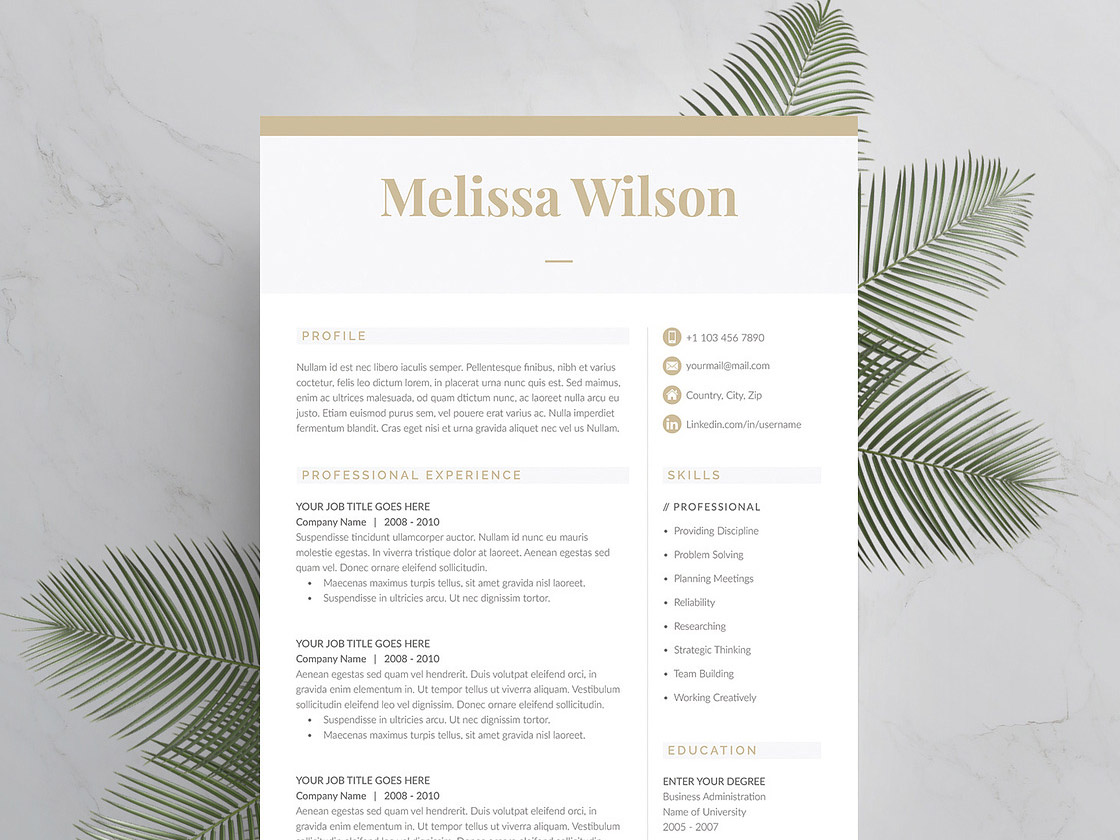
Quantitative Analysts combine advanced mathematics, statistical methods, financial knowledge, and programming expertise to solve complex problems across financial markets and investment industries. Their work may involve developing pricing models, evaluating market behavior, designing trading strategies, measuring portfolio risk, and building predictive algorithms that support financial decisions.
For professionals pursuing opportunities in investment banking, hedge funds, asset management, fintech, and quantitative research, a well-structured resume can help communicate technical capabilities and analytical achievements. The Quantitative Analyst Resume Template provides a professional framework for presenting your education, programming skills, financial modeling experience, research projects, and career accomplishments.
Designed for Microsoft Word, this editable resume package includes a two-page resume, a matching cover letter, and a references template. With A4 and US Letter versions available, it offers a flexible starting point for preparing applications across different financial and technology sectors.
Showcase Your Quantitative and Technical Expertise
Quantitative Analysts use mathematical and computational techniques to analyze financial data, evaluate investment opportunities, and develop models for complex business problems. Depending on their specialization, they may work with derivatives pricing, portfolio optimization, algorithmic trading, risk modeling, or financial forecasting.
This resume template helps you highlight experience in areas such as:
- Quantitative research and statistical analysis
- Financial modeling and valuation
- Algorithmic trading and strategy development
- Derivatives pricing and financial engineering
- Portfolio optimization and asset allocation
- Risk measurement and predictive modeling
- Econometrics and time-series analysis
- Machine learning and data analytics
- Market research and investment analysis
- Computational finance and numerical methods
Rather than simply listing technical capabilities, describe how you have applied them in practical projects. You might explain how you developed a pricing model, tested a trading strategy, analyzed historical market data, optimized portfolio allocations, or improved the performance of a forecasting algorithm.
Where appropriate, include measurable outcomes such as model accuracy, computational improvements, research findings, or backtesting results. Make sure that all figures are verifiable and that confidential trading strategies or proprietary investment information are not disclosed.
What’s Included in the Resume Package?
The template includes several editable documents and supporting resources to help you prepare a consistent professional application.
- Two-page resume template (.DOCX): Present your professional experience, academic qualifications, technical skills, research projects, and achievements.
- Matching cover letter (.DOCX): Introduce your background and explain your suitability for a specific quantitative position.
- References template (.DOCX): Organize professional references in a separate document when requested by an employer.
- A4 and US Letter sizes: Both page dimensions are included for different application requirements.
- 22 professional resume icons: Optional visual elements for enhancing the document layout.
- Font guide: Instructions for working with the template’s typography.
- FAQ and help guide: Additional information for editing and customizing the files.
- Customer support: Assistance included with the template package.
The coordinated resume and cover letter help maintain a consistent appearance throughout your application. You can customize both documents for different employers while preserving the original professional design.
Professional Resume Features
The template combines a modern visual presentation with editable sections, making it suitable for students, recent graduates, and experienced quantitative finance professionals.
Key features include:
- Fully editable Microsoft Word files
- Professional two-page resume layout
- A4 and US Letter paper formats
- Clean and organized document structure
- ATS-oriented formatting
- Customizable text, colors, and fonts
- Flexible section arrangement
- Dedicated areas for education, experience, and technical skills
- Space for research projects, certifications, and achievements
- 22 additional professional icons
- Matching cover letter and references documents
The structured layout helps you organize complex technical information without making the resume unnecessarily difficult to read. You can retain the original design or adjust selected elements to suit your professional preferences.
Easy Customization in Microsoft Word
The template uses the DOCX format, allowing you to edit its content in Microsoft Word on Windows or Mac and other compatible word-processing applications.
You can personalize your resume by:
- Replacing placeholder text with your personal information
- Updating employment history and research experience
- Adding academic qualifications and professional certifications
- Including programming languages and analytical tools
- Modifying colors and editable design elements
- Rearranging sections to emphasize technical expertise
- Tailoring the content for different quantitative roles
- Personalizing the matching cover letter
- Updating the references document when necessary
For quantitative positions, pay particular attention to technical skills and project descriptions. Employers often want to understand not only which programming languages you know but also how you have used them to solve analytical or financial problems.
Resume Formatting and ATS Considerations
Investment banks, hedge funds, fintech companies, and financial institutions may use Applicant Tracking Systems (ATS) to manage recruitment applications. A clear document structure can help recruiters identify relevant qualifications, although ATS parsing depends on the document’s underlying text structure and the particular software used by each employer.
Consider these recommendations when customizing the template:
Use recognizable section headings. Standard labels such as Professional Experience, Education, Technical Skills, Research Projects, and Certifications make your background easier to navigate.
Include relevant technical keywords. Terms such as Python, SQL, C++, statistical modeling, machine learning, financial engineering, and algorithmic trading can help communicate your expertise when they accurately reflect your skills.
Keep important information in editable text. Avoid placing essential qualifications exclusively inside icons, graphics, or decorative elements.
Explain your technical contributions. Describe the models, algorithms, research methods, or analytical systems you developed and the problems they addressed.
Review the reading order. Check that the resume content follows a logical sequence when copied into a plain-text editor.
Follow employer requirements. Submit the requested file format and prepare a simplified version if a recruitment process specifically requires a conventional ATS-oriented document.
A professional design can improve readability, but it does not guarantee ATS compatibility. Relevant qualifications, clear technical descriptions, and accurate achievements remain essential.
Who Should Use This Quantitative Analyst Resume Template?
Although designed for Quantitative Analysts, this template can be adapted for several related careers across quantitative finance, investment research, financial engineering, and data science.
Quantitative Finance and Research
- Quantitative Analyst
- Quantitative Researcher
- Quantitative Investment Analyst
- Financial Mathematics Analyst
- Computational Finance Specialist
Trading and Investment Strategies
- Algorithmic Trading Analyst
- Quantitative Trading Researcher
- Trading Strategy Developer
- Portfolio Optimization Analyst
- Systematic Investment Analyst
Financial Engineering and Risk
- Financial Engineer
- Derivatives Pricing Analyst
- Quantitative Risk Analyst
- Market Risk Modeler
- Financial Model Validation Analyst
Programming and Data Science
- Quantitative Developer
- Financial Data Scientist
- Machine Learning Research Analyst
- Statistical Modeling Specialist
- Financial Analytics Engineer
These roles involve different technical requirements and responsibilities. A quantitative researcher may emphasize statistical methods and academic research, while a quantitative developer may focus on programming, computational performance, and financial system implementation.
Customize your resume to match the employer’s investment strategy, technology environment, and technical requirements.
How to Write an Effective Quantitative Analyst Resume
1. Highlight Your Mathematical and Academic Background
Start with your educational qualifications, particularly degrees and coursework related to mathematics, statistics, physics, computer science, economics, or financial engineering. Include relevant research projects, academic achievements, and advanced technical subjects.
For recent graduates, academic research and independent quantitative projects can help demonstrate analytical capabilities when professional experience is limited.
2. Demonstrate Programming Proficiency
List programming languages and analytical tools that you have used in practical projects. Depending on your specialization, these may include Python, R, C++, SQL, MATLAB, Julia, and specialized financial modeling applications.
Explain how you used these technologies rather than simply presenting a long list of software names.
3. Describe Financial Models and Research Projects
Include examples of pricing models, portfolio simulations, predictive algorithms, statistical research, or trading strategy development. Briefly explain the objective, methodology, and outcome of each project.
4. Show Your Understanding of Financial Markets
Highlight relevant knowledge of asset classes, derivatives, market microstructure, portfolio theory, risk measurement, and investment strategies. Prioritize areas that match the position you are targeting.
5. Explain Your Analytical Achievements
Where possible, provide evidence of your contributions. Examples may include improving model performance, identifying statistical patterns, optimizing computational processes, or developing more effective analytical methods.
6. Prepare a Tailored Cover Letter
Use the matching cover letter to connect your technical background with the employer’s requirements. Mention relevant research, programming experience, or financial modeling projects that demonstrate your suitability for the role.
Software Requirements
The template is designed for Microsoft Word on Windows or Mac. A compatible version of the application is required to edit the DOCX files.
If Microsoft Word is not installed, other word-processing applications may also support DOCX documents, although formatting differences can occur. Review the final layout carefully before submitting your application.
Build a Professional Quantitative Finance Profile
An effective Quantitative Analyst resume should communicate more than mathematical knowledge or programming proficiency. It should demonstrate your ability to combine statistical reasoning, financial understanding, and computational methods to solve practical problems.
This editable Word resume package provides a convenient starting point, with a two-page CV, matching cover letter, references template, two paper sizes, and additional customization resources. Adapt the content to your target specialization, highlight your strongest technical achievements, and ensure that every qualification accurately reflects your experience.
Whether you are pursuing opportunities at an investment bank, hedge fund, asset management firm, fintech company, proprietary trading organization, or financial research institution, a focused and well-organized resume can help present your quantitative expertise and support your next career opportunity.
Related Free Resume Template


Related Products


Same Contributor


Featured Products


